
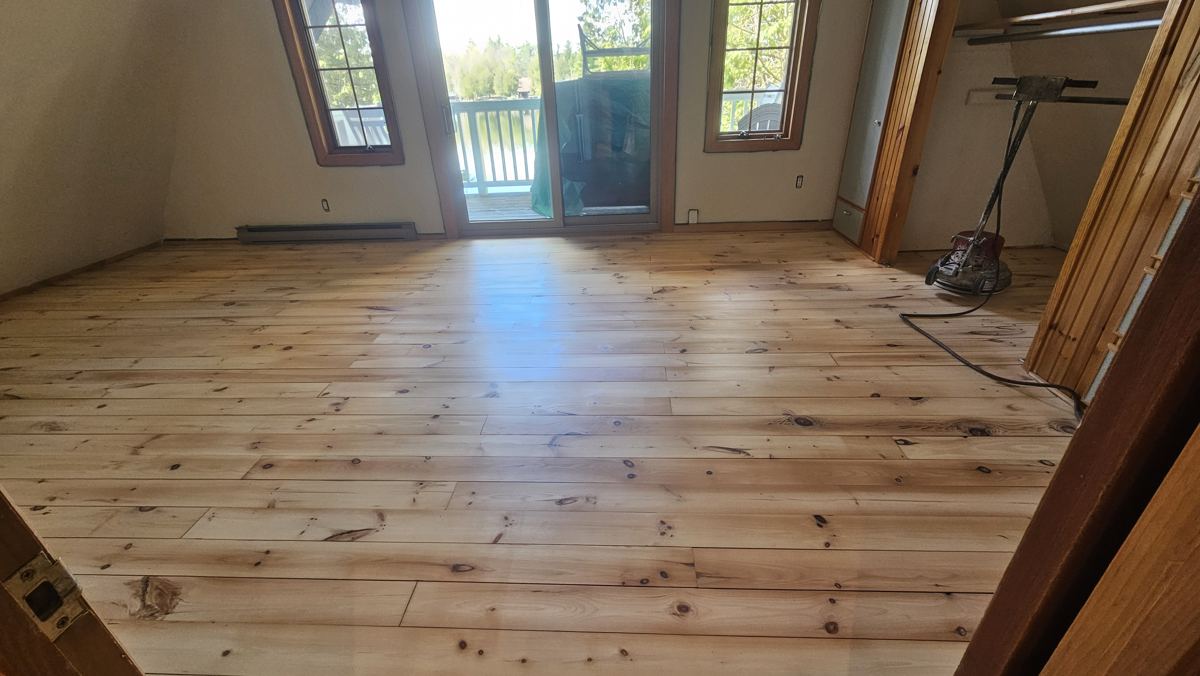
Every January we get the same phone call. Someone is standing in their living room in wool socks, looking down at thin dark lines that have appeared between their floorboards, wondering what went wrong and what it's going to cost. Almost always the answer is: nothing went wrong, and nothing. That floor is doing exactly what wood floors do in this city.
Wood Never Stops Breathing
Hardwood is hygroscopic. That's a long word for a simple idea: wood constantly exchanges moisture with the air around it. Humid air, the boards take moisture on. Dry air, they give it up. This never stops — not after installation, not after finishing, not after a hundred years.
And when the moisture content changes, the wood changes size. The important detail is that it moves almost entirely across the grain — across the width of a board — and barely at all along its length. That's why a floor doesn't buckle end to end when it dries out. It just gets a fraction narrower, board by board.
A fraction of a millimetre per board sounds like nothing. Multiply it by every board in the room and it's very visible: swollen boards press tight together, shrunken ones let the joints open up.
Why Ottawa Is a Worst-Case Scenario
Wood floors do this everywhere. Ottawa just does it harder. We get genuinely humid summers, and then we spend months in deep cold with the furnace running. Cold outdoor air holds very little moisture, and once you heat it up to living temperature, the relative humidity indoors falls off a cliff. Mid-winter indoor RH in an Ottawa house can sit well under 30%, and in a dry stretch with the heat cranked it can get near 20%. Come July, that same house is far more humid.
That annual swing — very dry to quite humid and back again — is much wider than what floors face in milder climates. So Ottawa floors move more. It isn't a defect in your house. It's the climate.
Which Floors Show It Most
- Wide planks. A 5" board shrinks roughly twice as much as a 2¼" strip for the same change in moisture. Same percentage, bigger number.
- Century pine. The wide-plank pine in the Glebe, Sandy Hill, Hintonburg, Lowertown and New Edinburgh gaps the most, and always has.
- Plainsawn versus quartersawn. How the board was cut from the log matters. Quartersawn wood moves noticeably less across its width than plainsawn — most modern strip flooring is plainsawn.
- 2¼" red oak strip, the standard Ottawa floor, moves least of the common ones — though you'll still see hairlines in February.
When It Actually Is a Problem
It would be a disservice to tell you every gap is harmless. Some aren't. Here's the honest list:
- Gaps that don't close in summer. Seasonal movement reverses. If the gaps are the same width in August as they were in February, they're permanent, and something other than the season caused them.
- Gaps you can lose things in. If one will catch a coin or a dog's nail year round, it's past cosmetic.
- Gapping in one area only. Even seasonal movement is spread across the room. If one section is opening up and the rest isn't, that points to a localised moisture source or a subfloor issue underneath — a bathroom, a dishwasher, a crawlspace, a duct.
- Cupping — board edges sitting higher than their centres. This means the underside is wetter than the top. Think leaks, a damp basement or crawlspace, or moisture coming up through the subfloor.
- Crowning — centres higher than edges. Often what you get when a cupped floor was sanded flat before it had dried out and returned to shape. It's a fixable mistake, but it's a mistake.
- Boards that have separated and now move, squeak or click underfoot, or fasteners that have worked loose. That's mechanical, not seasonal.
Any of those, get eyes on it — cupping especially. That's a moisture problem, and the floor is the symptom, not the cause.
What You Should Actually Do
The fix for seasonal gapping isn't done to the floor. It's done to the air.
- Run a humidifier through the winter. Whole-home on the furnace is ideal; portable units in the main living areas help. It's the single cheapest thing you can do for your hardwood.
- Aim for a stable 35–50% relative humidity, year round. A cheap hygrometer tells you where you actually are, which is rarely where you assumed.
- Deal with summer basement humidity too. A damp basement pushes moisture up into the floor above and is a common cause of cupping. Dehumidify it.
- Stop chasing extremes. A house that sits near 40% all year is far kinder to wood than one that ping-pongs between 20% and 60%.
- Don't rush to fill winter gaps. See below.
Why Filling Seasonal Gaps Backfires
This one is worth being blunt about, because it's a common and expensive DIY instinct. If you fill gaps in February, you're filling them at the exact moment the floor is at its most contracted — the widest those joints will ever be. Come summer, the boards take moisture back on and expand into space that is no longer empty. The filler gets crushed, squeezed up above the surface, or broken into crumbs that work loose over the following winter. Now you have a ragged, discoloured line instead of a clean seasonal gap, and it's harder to deal with than what you started with.
Permanent gaps are a different conversation. A gap that genuinely never closes can be addressed, and badly separated or damaged boards can be replaced — board repairs are a normal part of the work, done before any sanding starts. The distinction is just whether the gap still moves with the seasons, and one summer of paying attention answers that.
Timing a Refinish Around the Seasons
We refinish year round, which surprises people who assume winter is off-limits. Water-based finishes cure well indoors with the heat on, and the low odour matters more when nobody wants to open a window.
What matters is the state of the wood when we assess it. A floor at its most contracted in deep winter is showing its widest gaps, not its normal ones, and we factor that in rather than treating February as the permanent condition. More importantly, a cupped floor still carrying moisture should not be sanded flat — sand it wet and you get crowning when it finally dries. Find the moisture source, fix it, let the wood settle, then sand. For what happens once we do, here's our full sanding and refinishing process, and the gallery.
Common Questions
My floor gaps every winter. Is my installer to blame?
Almost certainly not. Seasonal gapping is the wood responding to your indoor air, and no installation method prevents it. Permanent gaps that never close are a different question and worth investigating.
Will refinishing get rid of the gaps?
Sanding and refinishing renews the surface — it doesn't change board width. Seasonal gaps will still open the following winter. Humidity control is what narrows them.
Should I stop worrying entirely?
Worry about the specifics listed above: gaps that don't close, gapping isolated to one area, cupping, crowning, and boards that move. Ignore thin, even, seasonal lines.
How do I know which kind I have?
Look at the floor in late summer, when it's at its most expanded. Whatever is still open then is permanent. Or have us look — the on-site assessment is free.