
It's the first question almost everyone asks, and it's a fair one: what's this going to cost?
We don't publish a number. A refinish isn't a product with a shelf price — it's labour, materials and time applied to one floor in one house. Two homes on the same street, same square footage, same builder, can be genuinely different jobs. What we can do is be straight about what moves the price up and down.
And one thing plainly: anyone who gives you a firm price over the phone without seeing the floor is guessing. Guesses get corrected later, usually on your invoice.
Square Footage — the Starting Point, Not the Answer
Area matters — more floor means more sanding, more abrasive, more finish. But square footage alone tells you surprisingly little, because layout changes how fast that area can be worked.
An open living-dining area is the most efficient floor there is: long uninterrupted machine runs, little perimeter relative to open field. The same area chopped into three bedrooms, a hallway and two closets is slower — more setup, more turns, far more edge work per square foot. Hallways are nearly all edge and turn; closets are hand work in a space you can barely stand in.
Stairs Are Their Own Job
Stairs get priced separately, always. If a quote quietly folds them into the floor rate, ask why.
There's no machine that sands a staircase. Every tread, riser, nosing and stringer is done by hand or with small detail sanders, one surface at a time, through the same grit sequence the floor gets — then finished by hand, usually in stages so you can still get up and down. A single flight can absorb as much time as a good-sized bedroom.
What Species You're Standing On
Species changes how fast a floor cuts and how much abrasive it eats — which is time and materials.
Red oak — the predictable baseline
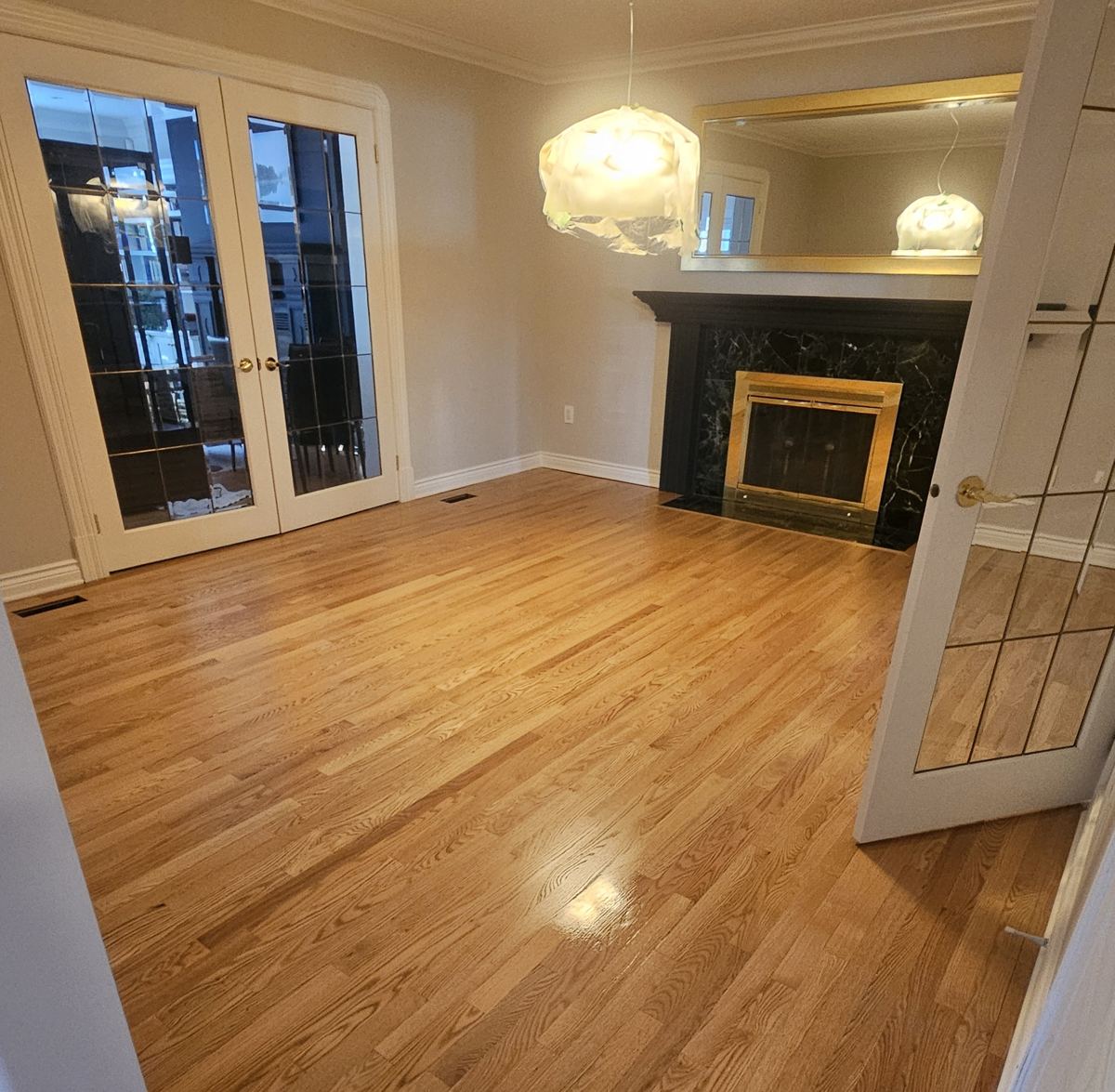
Most Ottawa floors from the post-war decades are red oak strip, and it's what everything else gets compared against: steady, predictable cutting and an open grain that takes colour evenly.
Maple — harder, slower, hungrier
Hard maple is denser than oak. It cuts slower, so the same room takes longer, and it dulls abrasive faster. Dull paper doesn't cut maple, it burnishes it — polishing the surface so finish won't bond — so the abrasive gets changed often rather than pushed.
Pine — soft, fast, unforgiving of a heavy hand
The century homes in the Glebe, Hintonburg and Lowertown are often wide-plank pine. It cuts fast, which sounds like good news and isn't: it's easy to take off far more than you meant to. Pine gets a lighter touch and more hand work around nail holes and old patches.
The Condition of the Floor
This is what most often separates a straightforward job from a complicated one — and the hardest thing to describe over the phone.
- Pet stains. Surface discolouration sands out. Urine that soaked into the wood — often black — can go deeper than the sandable layer, and those boards need replacing.
- Water damage. The question is how far down it went, and whether the subfloor is sound.
- Cupping. Raised board edges mean moisture. Sanding a cupped floor flat before it has dried is one of the worst things you can do to it — when it does dry, you get the opposite problem.
- Gaps. Thin winter gaps here are usually seasonal and close by summer. Permanent gaps are a different conversation, and filling is a separate step.
- Previous bad sanding. Drum stops, chatter, waves and edger dish-outs have to be cut out flat first. Fixing a bad sand costs more than doing it right would have.
- Board repairs. Splits, missing pieces, old vent cutouts — normal work, not a dealbreaker, but time and material.
How Much Floor Is Left
A hardwood floor has a finite wear layer — the wood above the tongue and groove — and every sanding takes some of it. Solid hardwood usually has life for several refinishes, but a floor already done two or three times has less room to work with.
Engineered flooring is the bigger question: its veneer ranges from thick enough to sand more than once to too thin to touch. We measure it before quoting, at a vent or threshold where a board edge is exposed.
Colour and Coats
Each colour option is a different amount of work.
- Clear sealer — the simplest path. The wood's natural colour, enriched.
- Tinted sealer — shifts the tone without a full stain. An extra product and extra care, but efficient.
- Full stain — a genuine extra stage: applying, wiping back, then drying time before any finish goes on. On a species that blotches, it also means sampling on your boards first.
Coats work the same way: more product, more drying time, often another day on site. A busy hallway or a house with large dogs is worth an extra coat; a spare bedroom probably isn't. See the range of results in our gallery.
What's in the Way, and How We Get In
An empty house is faster than a furnished one; if we're moving and staging your furniture room by room, that belongs in the quote. Appliances, built-ins and cabinetry get detailed around by hand, and closets are hand work start to finish.
Then there's getting the machines in. Belt sanders, edgers and planetary sanders are heavy — a walk-up, a condo with a booked elevator window, or a long carry from street parking all add time before a board gets sanded.
What a Good Quote Includes
A quote should tell you all of this without your asking:
- Which rooms are included, and their measured size
- Stairs as their own line
- The full grit sequence and edge work — not just "sand and finish"
- Which sealer and finish, and how many coats
- Any board repairs identified at the assessment
- Furniture handling: who moves what
- A schedule — days on site, drying windows, when you can walk on it and when rugs go back
"No surprise extras" means the price you agree to is the price you pay. The only thing that should change it is something genuinely hidden — damage under the old finish nobody could have seen. Then you get a phone call and a decision before the work happens, not a line item at the end.
The Low Quote Trap
If one quote comes in well below the others, something has been left out. Almost always it's one of two things, both invisible on bare wood.
Skipped grit steps. Sanding is really the process of replacing coarse scratches with progressively finer ones. Jumping from a rough grit straight to a fine one saves real hours and looks fine on raw wood — then the finish goes on and those deep scratches telegraph through the sheen under raking light. Permanently, unless the floor is sanded again.
Rushed edge work. The edger is slow, physical and easy to do badly. Cut corners and you get a visible band around the perimeter of every room — the "picture frame" — plus swirl marks that only appear once there's a coat on them. We walk through the stages in our post on how floor sanding works.
Both fail the same way: you can't see the problem until the job is finished and paid for.
So What Does It Cost?
We'll know once we've seen it, and you'll know a business day later. If your floor isn't a good candidate for refinishing, we'll say so and talk through the alternatives rather than sell you a job that won't work.