
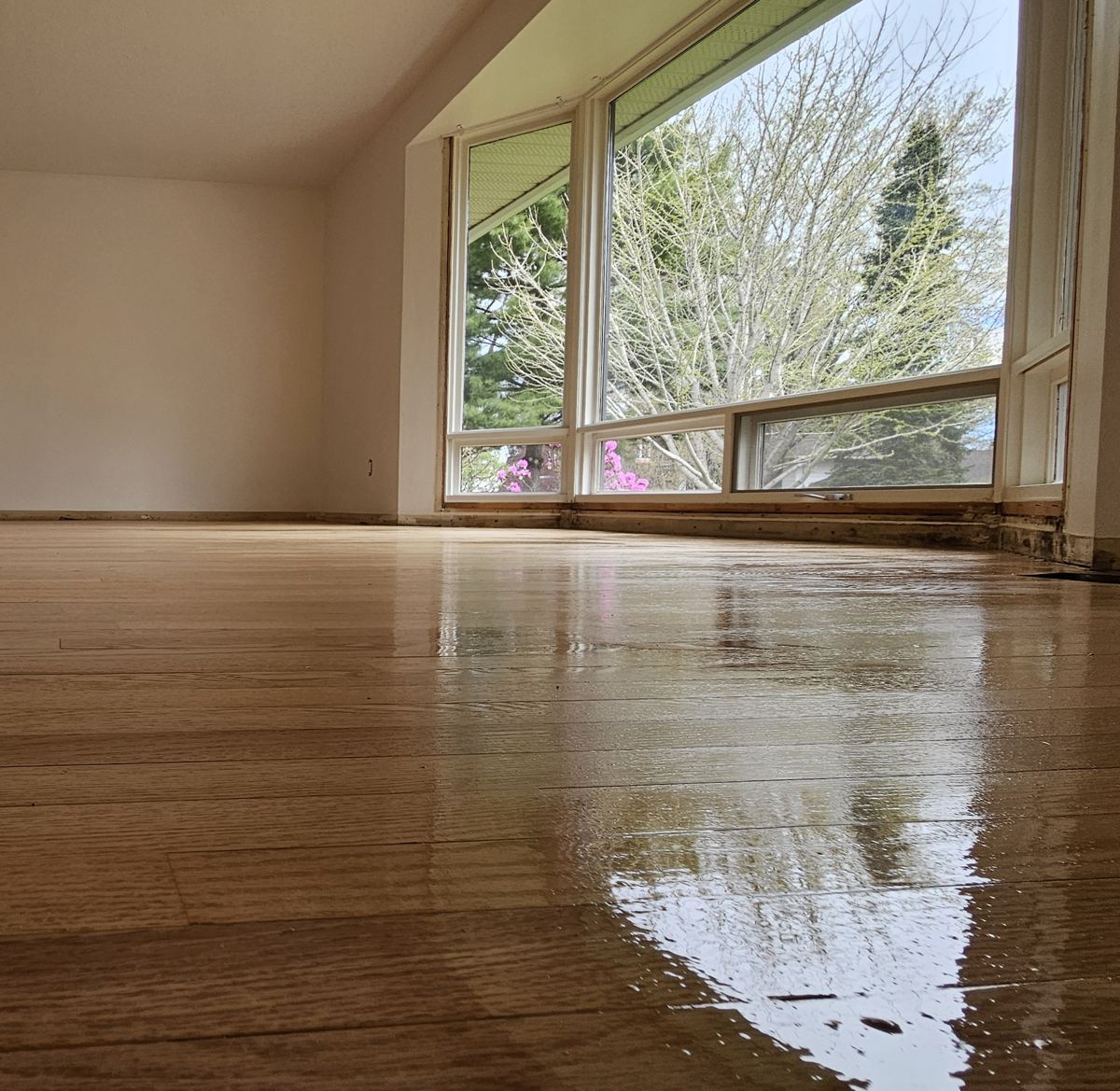
People call us with the same sentence all the time: "I think our floors are past saving." Then we get there, look at the boards, and the honest answer is usually the cheaper one — they're fine, they just need refinishing.
Most floors homeowners have written off can be brought back. But not all of them, and it would be dishonest to pretend otherwise. The limits are real, physical, and measured rather than guessed at. Here's how to tell which side of the line your floor sits on.
What Looks Catastrophic but Almost Always Sands Out
Most of what makes a floor look ruined lives in the finish and the top fraction of the wood, and sanding removes that layer completely. You're not covering damage up — you're taking it off and starting again from raw wood. All of the following are routine, not dealbreakers:
- Deep scratches and gouges from dog claws, dragged furniture and decades of traffic
- Finish worn clean through in hallways, doorways and in front of the kitchen sink, where the wood has gone grey and fuzzy
- Sun fade and UV shadows — bleached patches near windows, and the dark rectangle where a rug sat for years
- Dark pet stains, which look alarming but are frequently shallower than they appear
- Water marks and white rings from planters, radiators and spilled everything
- Dated orange and yellow finish from 1980s and 1990s oil-based polyurethane that has ambered
- Paint spills and drips from past renovations
- Dents and dings, which soften considerably once the surface is cut flat
Colour surprises people most. A floor you dislike for being too orange doesn't need ripping out — it needs its old finish removed and a different sealer or stain put on. Once we're at bare wood, the colour decision is wide open again. For the mechanics, see how professional hardwood floor sanding actually works.
The Real Limits — Said Plainly
Now the other side — where refinishing genuinely isn't the answer, and we'd rather tell you before the job than after.
Not enough wear layer left
Solid hardwood can typically be refinished multiple times over its life — that's the appeal of it. But every sanding takes material away, and there's a limit: the tongue of each board, and the nails holding it down. Sand past that and the boards lose their structure.
So the question isn't "how old is this floor," it's "how much wood is left above the tongue." We measure that on your boards, usually at a threshold, vent cut or stair nosing where an edge is visible. Nobody can tell you from a photo.
Engineered flooring with a thin veneer
Engineered flooring is a real wood veneer over a plywood core, and veneer thickness varies enormously between products. Some take one careful refinish. Some take none — sand them and you go straight through into the plywood, with no fixing it afterwards. We measure before quoting, every time.
Floors sanded down to the nail heads
If you can see nail heads sitting flush with or above the board surface, the floor has already given everything it had. Running a sander over exposed nails wrecks abrasive and machine both, and there's nothing left underneath worth exposing.
Problems underneath the floor
Refinishing does not fix what is below the boards. Subfloor damage, sagging joists, or widespread rot from a long-term leak are structural problems, and a beautiful new finish on top solves nothing. Soft or springy areas have to be opened up and dealt with first — sometimes that means the flooring above comes out.
Severe cupping or crowning with an active moisture source
Cupping (board edges higher than centres) and crowning (the reverse) are the floor telling you it's dealing with moisture. Sanding it flat while it's still wet is the classic expensive mistake: it dries out later, moves again, and now you have a thinner floor that's cupped a second time.
The order matters — find the moisture source, fix it, let the floor dry and flatten, then sand. If the source can't be resolved, or flattening would eat the entire remaining wear layer, replacement is the honest recommendation.
Laminate and vinyl
Neither can be sanded at all. Laminate is a printed photographic layer, not wood; vinyl is plastic. If that's what you have, replacement is the only route — and we do hardwood and vinyl installation too, so we can take it either way.
Board Repairs: The Middle Path Most People Don't Know About
This rescues more floors than anything else. Damage is rarely spread evenly across a room — it's concentrated. A burnt patch by the woodstove, boards blackened where the dog slept, a stretch chewed up by a leaking fridge.
Those boards don't condemn the floor. They come out individually and get woven in with replacement stock matched for species and width, before any sanding. The whole floor is then sanded and finished as one surface, so the repair disappears into it instead of sitting there as an obvious patch.
A great many floors people assumed were write-offs are really a handful of board repairs followed by a normal refinish. See how they turn out in our gallery.
Why This Matters Especially in Ottawa
Ottawa's housing stock makes this a bigger question here than in a newer city. In the Glebe, Sandy Hill, Hintonburg, Lowertown and New Edinburgh we regularly work on wide-plank pine that has been underfoot for a century or more. Out through Alta Vista, Elmvale Acres, Nepean and Beacon Hill, the post-war suburbs are full of original 2¼" red oak strip.
An enormous number of local floors are original — and worth saving on their own merits. Old growth wood in them is often denser and finer-grained than what you'd buy new today, because it grew slowly. When someone wants to tear out century pine for something modern, we'll at least make sure they know what they're giving up.
Refinishing vs. Replacing: The Practical Comparison
Where refinishing is possible, it's generally the less disruptive and less expensive route. No tear-out, no disposal, no waiting on flooring orders — the floor stays put and gets reset. It keeps the character too: original boards and widths, the patina and nail holes a hundred years put there. And it produces far less waste, since nothing goes into a bin.
Replacement makes sense when the wood has genuinely run out, when something structural has to be fixed underneath, or for reasons unrelated to the floor's condition. All legitimate. We just want the decision made on the facts of your floor.
Common Questions
How do I know how many times my floor has been refinished?
Usually you can't tell from the surface, which is why we measure. A visible board edge at a vent, threshold or stair nosing tells us what's actually left.
My floor is black in places. Is that permanent?
Not necessarily. Some dark staining is surface-level and sands out; deeper staining is handled by replacing those boards before sanding. Either way it's usually localised, not a whole-floor problem.
Can you refinish just one room?
Yes, though a freshly refinished room will look different from adjoining older floors. We'll talk through where a natural break point sits.
What if you get here and tell me it needs replacing?
Then that's what we'll tell you. We're owner-operated and fully insured, and we do installation as well as refinishing — so we have no reason to push you toward one answer over the other.