
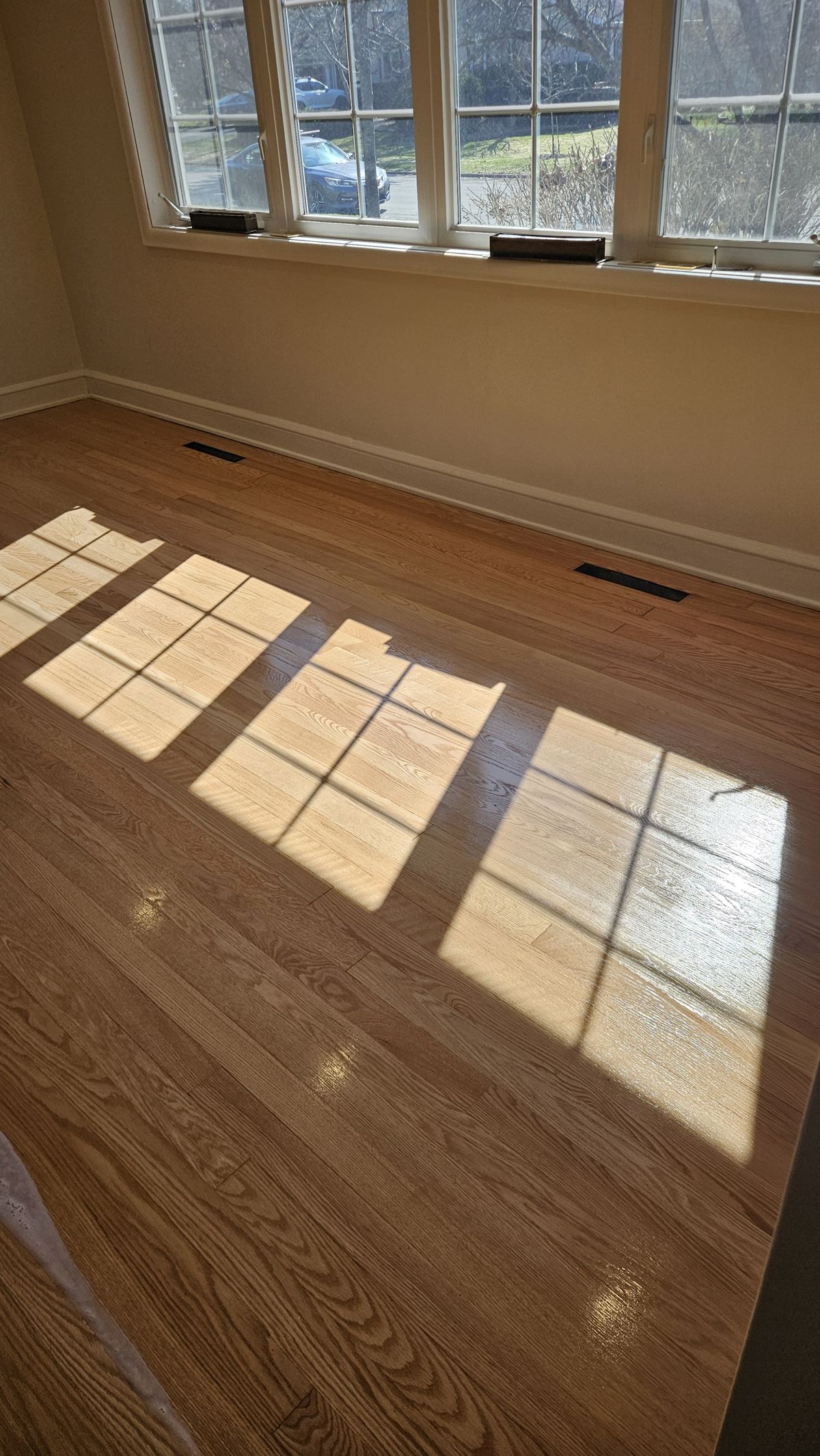
Once your floor is sanded back to bare wood, one decision is left that changes everything about how it looks and how it lives: what goes on top. In practice that means two products — water-based (waterborne) finish, or oil-based polyurethane, sometimes called oil-modified poly.
We use water-based, and we'll explain why. But this isn't a hit piece — oil-based poly has been on floors for decades for good reasons. Here's the honest version.
Colour: The Difference You'll See Immediately
This is the biggest practical difference, and the one most people don't find out about until after the fact.
Oil-based goes on warm — and keeps going
Oil-based polyurethane has a natural amber tone straight out of the can, and it doesn't stop there: it continues to yellow and deepen over the years. A floor coated in oil-based poly today will be noticeably warmer and more golden in five years. That's not a defect — it's simply what the product does, and it's predictable.
Water-based dries clear and stays close to it
Waterborne finishes go on milky and dry essentially clear. They enrich the grain the way any finish does, but they don't lay a sheet of amber over the wood and don't march toward yellow over time. The colour you signed off on is roughly the colour you keep.
That matters more in Ottawa than you'd think, because of what's under our feet. Red oak — the default floor in most post-war Ottawa homes — already has a pink-red undertone. Add amber and you get a distinctly orange floor. Maple and birch have a pale, creamy colour that amber muddies immediately. If you want a light, natural or white-oak-inspired look, an ambering finish fights you the whole way.
Where oil-based genuinely wins
Plenty of people love that amber glow, and they're not wrong to. On oak in an older home — original trim, warm paint, period character — the honeyed look of oil-based poly is genuinely beautiful and completely appropriate.
You don't need an oil-based finish to get there, though. A tinted sealer or stain under a clear water-based topcoat gives you that warmth deliberately, at the tone you chose, without the floor drifting further amber every year after. We sample colours directly on your own sanded floor before you commit — see our gallery for how different the results can look on the same species.
Odour and VOCs: The Difference You'll Smell
Oil-based polyurethane carries solvents and smells like it. The odour is strong, it lingers well past the point where the floor is dry, and it carries through the whole house. VOC content is high. This is the most common reason families end up sleeping somewhere else for several days.
Water-based finish is low odour and low VOC — a mild smell while we're coating that clears quickly. In most homes we stage the work room by room and you never have to leave.
With young kids, pets, anyone with asthma or chemical sensitivity, or simply nowhere else to go, this stops being a preference and becomes the deciding factor.
Dry Time and Cure Time — Not the Same Thing
People use these words interchangeably and shouldn't.
- Dry — hard enough to recoat or walk on carefully.
- Cured — at full hardness and chemical resistance. Always considerably later than dry.
Water-based dries fast enough that we can often get multiple coats on in a single day, and you can typically walk on it in socks within hours of the last one. Oil-based needs far longer between coats, which stretches the whole job out.
Durability: Let's Deal With the Old Myth
The most persistent thing we hear is that water-based finish "isn't as tough." That was once fair — the first generations of waterborne floor finish were genuinely softer than oil-based poly. The reputation outlived the products by decades.
Modern commercial-grade waterborne finishes, particularly two-component systems where a hardener is mixed in before application, are a different product entirely. They're specified for gymnasium floors and commercial spaces that see traffic no house will ever match. In a family home, properly applied, they hold up to kids, dogs and daily life.
The honest caveat: quality varies enormously across water-based products. A cheap consumer-grade waterborne finish is not a commercial-grade two-component one, and comparing the cheap version to good oil-based poly is where the myth keeps getting refreshed. Ask what's going on your floor.
Sheen: Matte Through Gloss
Both come in the full range — matte, satin, semi-gloss and gloss — so sheen isn't a reason to pick one over the other. It's still worth thinking about:
- Matte and satin scatter light, hiding dust, pet hair, micro-scratches and footprints remarkably well. This is what most Ottawa families choose.
- Semi-gloss and gloss look striking in a formal space but show every speck of dust and every fine scratch. On a busy floor, gloss is a commitment to cleaning.
Maintenance and Recoating
Neither finish is forever, but neither has to mean a full resand when it starts looking tired. Both can usually be screened and recoated — surface lightly abraded, fresh coat on top, no cutting into the wood. Caught at the right time that's a fraction of the labour of a full sand and refinish, and it buys the floor years.
The catch is compatibility: what's already on your floor determines what can go over it. Some combinations bond fine, others don't, and a recoat that doesn't bond peels. Worth knowing what finish your floor has — and if nobody knows, it can be tested. We'd rather test than guess.
Cost
Straight answer: water-based products generally cost more per litre than oil-based ones, and that shows up in the quote. Quality waterborne finish is not cheap material.
What you get back is time and livability — a faster job, fewer days of disruption, no hotel or in-laws, and a floor that keeps the colour you chose. For most families we work with, that trade isn't a close call.
Our Verdict for Ottawa Family Homes
We finish with water-based products, and the reasoning is practical rather than ideological:
- Most of what we sand here is red oak, maple or birch — the species where ambering does the most damage to the colour people asked for.
- Homes with kids and pets can't easily be emptied for days, and low odour means they don't have to be.
- Fast dry times mean fewer days with the house upside down.
- The durability argument against waterborne finish stopped being true long ago.
If what you want is a deep amber glow on oak, say so — that's a legitimate look, and we'd rather build it deliberately with a tinted sealer under a clear coat than have you arrive at it by accident. Either way, that conversation belongs before anything gets coated.
Common Questions
Does water-based finish yellow over time?
No. It dries clear and stays far closer to the wood's true colour. Ambering over the years is specifically an oil-based characteristic.
Is water-based finish as durable as oil-based?
Modern commercial-grade waterborne finishes stand up to real family life. The "soft" reputation comes from early formulations that stopped being state of the art a long time ago.
Do I have to move out?
With water-based, usually not — it's low odour and low VOC, and we stage the work around you. With oil-based, most families end up leaving for several days.
When can furniture and rugs go back?
Socks-only traffic within hours of the last water-based coat, light furniture within days. Give it about a week before heavy pieces and area rugs return, whichever finish you used.